
Ex-Oiler Stoll, Ex Mrs Rod Stewart engaged.
Clearly, Ms. Hunter was not put off by her hubby-to-be's whopping three ES goals and -23 rating last season.
Equally apparent is the fact that we're still a long way from hockey season.
"They're going to spin it in the best light possible," said University of Alberta sports economist Brad Humphreys.
"It's sort of as a piece of propaganda, I think. That's the way to think about it.
"It's not the whole truth. There is useful information in there, but there's also information that should be out there that's omitted — just like any other propaganda piece that you might expect out of people that are seeking taxpayer dollars that is primarily going to be used by private enterprise."
 This is Jessica Biel. She isn't Scarlette Jo, Jessica Alba or Jennifer Aniston. She isn't even blonde. She's not an A-list celebrity. However, she's still smoking hot, gorgeous and rich. Any guy would kill to take her home, but no one would confuse her with Scarlette Jo. It's the end of the long weekend for most, but mine is just beginning, as I had today off and have the next two days off as well. Drunken debauchery will certainly take place at some point over this time, but for now, I'm just thinking about the Oilers and blue skying about next season. I'm making sure that we're not bringing home Scarlette Jo, but I can't help but think we have a shot at Jessica Biel, especially if we buy her a few glasses of an expensive wine she's never heard of.
 I'm of the opinion that Ales Hemsky is an elite player in this league. He is without a doubt a top 10 RW, and I think he's going to get the bounces this year, finish in the top 5 in his position for scoring, and finally be considered just as good as he is - because right now he very well could be the most underrated player in the league. Last season, after a slow start, he took off, finishing the last 60 games at a PPG pace. There was a 30 game period in there where he was dominant, followed by another 30 games where he continued to score despite playing most games with an anchor like Jarret Stoll. Desjardin's likes him, his PPP/60 numbers are disgusting, and with the edition of Visnvosky and a "healthy" Souray to his utilization, I can only imagine that it's going to improve. I expect Hemsky, along with Cole and Horcoff, to take the toughest minutes. I also expect career seasons for the trio. In a blueskying role, I hope that Cole takes to loving the atmosphere and the players here, and signs an identical extension to his last one - $12,000,000/3 years. Frontloaded, just so he gets a few more bucks from Mr. Daryl Katz.
 Clockwork Orange treatment, while being forced to get into the kind of shape that guys like Horcoff, Staios and Moreau are known and praised for? Will he have found that extra stride and that extra glare? If he does, all bets for this season are off immeadiately, because players like that come around to an organization once in a generation, and if he can be anywhere near what Bertuzzi was for the Canucks from '98-'02, we're in for one hell of a treat. That's not the only question though, what can we expect from Pisani? Can he continue to play the game despite his illness? Will he remain an outscorer, able to play against anyone and put up results? And if both of these players show up, how good does Brodziak have to be to pass as the 3rd line C? Clearly the organization loves him - he was at the Indy party and the Katz presser. If he's in shape and can find an extra gear, will he be good enough to be on the ice against Iginla? Gaborik? You have to imagine the organization believes it, and if he does he'll have a $3,000,000/2 year extension in his future.
 The Oilers have the least amount of question marks coming into this season that they've had in as long as I can remember. We're not asking who the #1 C is. We're not asking where the goals will come from. We're not asking who can play defense. We're not asking who will be in net.
 The signing of Matty Garon was widely complimented around the Oilogosphere and HFBoards, and he lived up to it last season, posting a .913 SV% along with being absolutely dominant in the SO. You have to imagine Edmonton management would be very happy if he could simply show a repeat performance while starting 60 games instead of 47. I imagine if he does repeat a similar season, he'll get a contract very similar to the one that Dwayne Roloson inked just over 2 years ago. Speaking of Roloson, he had one hell of an up and down season last year. Going from starter, to being supplanted by Garon, to having to go back in net, and doing well, when Garon was injured late in the season and the Oilers were making a legitimate push for a playoff seed. I'd assume that if he can pull off an average SV% and be a calming factor in the room the Oilers would be very happy with that, and it would show in the standings as well.
Below I outline a list of reasons that promote optimism of the 2008-2009 Edmonton Oilers franchise. I follow up with an outline of reasons to curb that enthusiasm.
REASONS TO BE OPTIMISTIC
CURB THAT ENTHUSIASM
VERDICT
Please continue to remain optimistic.
I like Tambellini's gold medal track record, yes, but his Stanley Cups won decades ago as a player record is severely lacking. How can he be the one to lead us to the promised land?


Please refer to Part I of Long-Term Contracts motivations, before continuing this read.
There are several legitimate motivations for General Manager, Kevin Lowe to extend goaltender Mathieu Garon this summer. These are outlined and briefly discussed below:
MOTIVE #1 – RISK & REWARDS OF CONTRACT TERMS ARE EQUITABLY DISTRIBUTED
Presumably, the contract terms, from the organization's standpoint present at least a moderate possibility that the benefits of the Garon's services will exceed the value of the cumulative paycheques. The Oilers would be seeking player overperformance of the contract. Garon, meanwhile, would be seeking the security of the paycheques that will allow him, his immediate family, and grandchildren a life of sailing on yachts, eating bonbons, sipping refreshing drinks in tropical climates subsequent to retirement. In short, financial security.
MOTIVE #2 – LACK OF SUITABLE ALTERNATIVES
General Manager Kevin Lowe would sign Garon to a long term extension if he reasonably feels there are:
This motivation presents profound leverage to the player in contract negotiation
MOTIVE #3 – CONTRACT STRUCTURE PRESENT UNIQUE OPPORTUNITIES
General Manager Kevin Lowe would sign Garon to a long term extension if the contract can be structured in a manner that provides the Oilers with unique opportunities, in the case of significant underperformance, such as:
Of course with this option to be viable, strong ownership commitment would need to be prevalent. Given Garon is still relatively young, option (b) is unlikely if such an extension is equal or less than 5 years.
DEMOTIVATION #1 – INHERENT RISK
On a collective basis long-term contracts to goaltenders carry more inherent risk than do long-term contracts to defensemen and forwards.
In other words, there are greater potential adverse consequences as a result of subsequent poor performance by a goaltender than of other roster players!
Why? By virtue of the number of designated roster spots for a specified position. There is only one starting goaltender per team, while six starting defensemen, and a whopping twelve starting forwards every game.
Case in point: Sheldon Souray, who is paid like a top pairing defenseman. Despite the fact that he won't ever live up to his paycheques in his present contract, the damages can still be mitigated by playing him in a role in which he can still help the team win hockey games [i.e. bottom pairing, penalty kill, and arguably the powerplay]. With a goaltender like Mikka Kiprusoff, the opportunity for mitigating damages is narrow, given the inherent risk present. Continuing playing him, in the event of poor performance, leads to poor results on the ice; relegating him to backup duty represents a significant waste of otherwise available cap space. In other words, consistently poor performance generated by a goaltender with a long-term contract is filth; and filth carries limited to negligible value around the league.
FINDING THE BALANCE
The key here is balance. Extending Garon to a long term contract is fine, if at inception of contract, the presumable benefits exceed the costs. That is, the strength of the motivations exceed the strength of the demotivations. If I am Kevin Lowe, I have assessed risk for Garon at moderate. The exhibit below represents my comfortable contract offers (please note 1 and 2 year contracts are not classified as long-term contracts):
Number of Years | NHL Salary Cap Hit (USD) |
1 | 4.00M |
2 | 3.75M |
3 | 3.50M |
4 | 3.25M |
5 | 3.00M |
6 | 2.75M |
Does that get it done? Perhaps. Perhaps not. The key is assessing the risks, and accordingly acting upon them. Kevin Lowe likely has the hammer [leverage] right now, given Garon's presumable desire for security. It would make good sense to utilize and derive benefit from this very hammer.
What do you offer, if you are Kevin Lowe?
 If one thing can be unquestionably said about Rob Schremp, he's one hell of an interesting character. Scouts said he had the talent to go top 3 in his draft year, but because of "attitude" problems, he plummeted all the way to 25th, at which point the Oilers rolled the dice on him. Contrary to what scouts want us to believe, it looks like he very well will find a niche in the NHL, but it's not going to be as a #1 line C, and he's not going to be a lesser player because of his attitude or a waste of natural talent.
 This is Mathieu Roy, seeing stars and realizing how little he's missing the NHL by*. The Oilers currently have him on a one-way contract that will pay him $500,000. I think that, regardless of what he does during camp, Roy will either end up in Springfield, be claimed on waivers by another team, or dealt for a late round draft pick. The signing of Strudwick truly made Roy redundant, and I see no reason for him to remain on the team, even though he is a character guy and he is a decent option as the 7th D.
...If the player is traded or claimed on Waivers prior to the no-Trade or no-move clause taking effect, the clause does not bind the acquiring Club. An acquiring Club may agree to continue to be bound by the no-Trade or no-move clause, which agreement shall be evidenced in writing to the Player, Central Registry and the NHLPA, in accordance with Exhibit 3 hereof...

It's rumoured that Ray Ferraro, formerly with NBC and Rogers Sportsnet, will sign with TSN. - William Houston
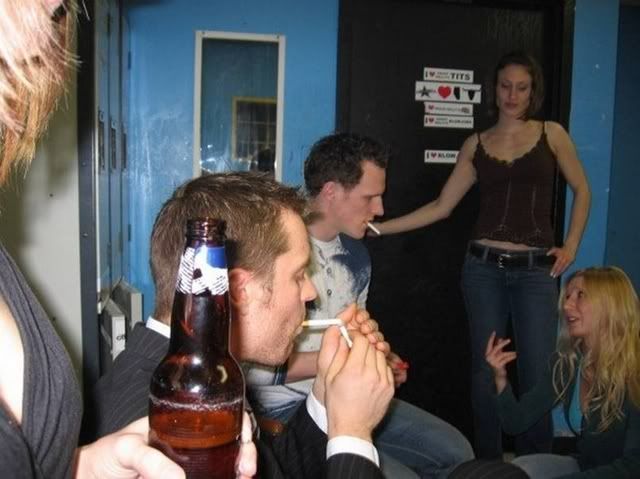 Cheap smokes and cheaper women; the life of a superstar in Calgary. What amazes me about this picture every time I see it, is just how ugly these girls actually are. That said, there's a bit more to be said about the Flames than questioning the personal life choices of guys like Phaneuf and Kiprusoff. I mean, everyone has had a few too many at one time or another and at least considered taking home a goal who could be described as having a "good personality" at best. It's a fact of life, and I suppose no amount of money changes the fact that booze is a good way to come up with a lot of bad ideas in a short period of time.
LONG TERM CONTRACTS
Kevin Lowe has not hesitated in signing players to "long-term contract," or acquiring those who have such contracts already in place, under the NHL Salary Cap operating system. In this exercise, I examine and discuss various underlying motives for this strategy, their costs and benefits, and then apply the analysis to the case of the Edmonton Oilers. Please note there can be more than one possible motive for each individual player. Also, please assume for the exercise's purpose, a "long-term contract" is defined as a SPC equal or greater than 3 years and exclude all entry-level contracts.
Using this benchmark criterion, the table below displays the long term contracts Kevin Lowe has compiled, post-NHL lockout.
PLAYER | AVERAGE SALARY (USD) | DURATION (IN YEARS) |
Horcoff, Shawn (2nd) | $5.500 | 6 |
Hemsky, Ales | $4.100 | 6 |
Gilbert, Tom | $4.000 | 6 |
Pronger, Chris | $6.250 | 5 |
Souray, Sheldon | $5.400 | 5 |
Visnovsky, Lubomir | $5.600 | 5 |
Penner, Dustin | $4.250 | 5 |
Staios, Steve | $2.700 | 4 |
Pisani, Fernando | $2.500 | 4 |
Moreau, Ethan | $2.000 | 4 |
Roloson, Albert | $3.667 | 3 |
Horcoff, Shawn (1st) | $3.600 | 3 |
Lupul, Joffrey | $2.667 | 3 |
Torres, Raffi | $2.250 | 3 |
Nilsson, Robert | $2.000 | 3 |
Stortini, Zachery | $0.700 | 3 |
I now discuss the underlying motives a General Manager may have for signing players to such contracts.
MOTIVE #1 – RISK & REWARDS OF CONTRACT TERMS ARE EQUITABLY DISTRIBUTED
The General Manager will sign a player to a long-term contract in a situation in which the risks and rewards of the contract terms are equitably distributed. In such a scenario, there are mutual benefits to both the player and the organization and consideration is given up by both of the mentioned parties. From the organization's standpoint, there exists at least a moderate possibility that the benefits of the player's services will exceed the value of the cumulative paycheques. From the player's standpoint, the security the contract provides is desirable, given consideration to possible unanticipated future events such as long term injury or declining performance. The marginal utility of security is such that the player would have a preference of it over the possibility of earning $X more dollars over the length of the contract, had the player signed a contract shorter in duration. In other words, the player is said to be risk averse, preferring instant gratification over the possibility of longer term gains.
This motive is appropriate in certain circumstances; not so in others.
Some examples of appropriate circumstances include:
Some examples of inappropriate circumstances include:
MOTIVE #2 – LACK OF SUITABLE ALTERNATIVES
The General Manager will sign a team's existing player, whom is approaching unrestricted free agency, to a long-term contract when he feels the player fulfills a role or team need and that such role or need cannot be efficiently and effectively replaced by immediate internal recruitment.
The General Manager's grounds for justification for the length of the contract would be twofold:
It would not be justified to sign a player to a long-term contract when:
MOTIVE #3 – FREE AGENCY
The sheer nature of the NHL's Unrestricted Free Agency results long-term offers in obtaining the services of such a player. This, of course, makes sense; the leverage the player holds in such a situation leaves teams with no alternative option but to offer longer terms, to presumably improve their organization on an overall basis, at least so immediately.
This motive is once again, appropriate in certain circumstances; not so in others.
Some examples of appropriate circumstances include:
Some examples of inappropriate circumstances include:
MOTIVE #4 – RESTRICTED FREE AGENCY OFFERSHEETS
The sheer nature of the NHL's RFA Offersheet program, generally results a General Manager to offer long term contracts, in the process of obtaining the services of a restricted free agent. This is because RFAs subject to an offersheet are typically young players with escalating performance, and in an attempt to ensure the benefits of the player's services will exceed the cost (Salary + Draft Picks), a long term contract is offered. Such an RFA will likely be overpaid in earlier years, but the underlying goal is such a player overperforms the contract in the later years. Such overperformance is more likely if the contract is greater in duration.
This motive is once again, appropriate in certain circumstances; not so in others.
Some examples of appropriate circumstances include:
Some examples of inappropriate circumstances include:
MOTIVE #5 – CONTRACT STRUCTURE PRESENT UNIQUE OPPORTUNITIES
An innovative General Manager may sign a player to a longer term contract, such that the contract is structured in a manner to present the organization with unique opportunities in later years. These opportunities are discussed below:
APPLYING THE CASE ANALYSIS TO THE EDMONTON OILERS
Horcoff, Shawn (2nd),
Hemsky, Ales,
Gilbert, Tom
Pronger, Chris
Visnovsky, Lubomir
Penner, Dustin
Horcoff, Shawn (1st)
Lupul, Joffrey
Nilsson, Robert
Stortini, Zachery
Souray, Sheldon
Roloson, Albert
Moreau, Ethan
Horcoff, Shawn (2nd)
Hemsky, Ales
Visnovsky, Lubomir
Staios, Steve
Pisani, Fernando
Moreau, Ethan
Horcoff, Shawn (1st)
Roloson, Albert
N/A
Souray, Sheldon
Penner, Dustin*
Penner, Dustin*
Souray, Sheldon
Visnovsky, Lubomir
Staios, Steve
Roloson, Albert
N/A
CONCLUSION
There are several motives for an NHL General Manager to sign players to a long-term contract, or acquire players who are in one. The above compiled analysis does not evaluate the actual contract, which is influenced by other factors. Rather, the analysis evaluates the underlying motive behind the long-term contracts, and whether the circumstances surround the motive was appropriate or not. In appears on surface, Kevin Lowe has reasonable grounds for justification of the majority of his long-term contracts either signed or acquired.
Please review the analysis, and chime in with your opinion and/or feedback.
 And isn't he just beautiful?


A superstar player can lead to winning and thus towards a new arena, LaForge says. “You win championships and motivate a community to say, ‘We can do better. We’re bigger, more important, more valuable to Canada and to hockey, if you will. So we need to invest.’ ”
- The Cult of Hockey
From a hockey perspective, there would have been absolutely nothing wrong with standing pat this summer, giving Jarret Stoll one more year to see if he can fully recover from his concussion, giving Joni Pitkanen another chance to show he just might be an All-Star puck-moving defenceman, giving Matt Greene a much deserved chance to establish himself as the new Jason Smith of the Oil blueline, a rugged team leader capable of playing against tough opposition.
Frankly, that would have been the prudent course of action if the Oilers focus was slowly building towards a Stanley Cup winning team, putting pieces in place around the likes of Sam Gagner and Andrew Cogliano.


 Posts
All Comments
Posts
All Comments


